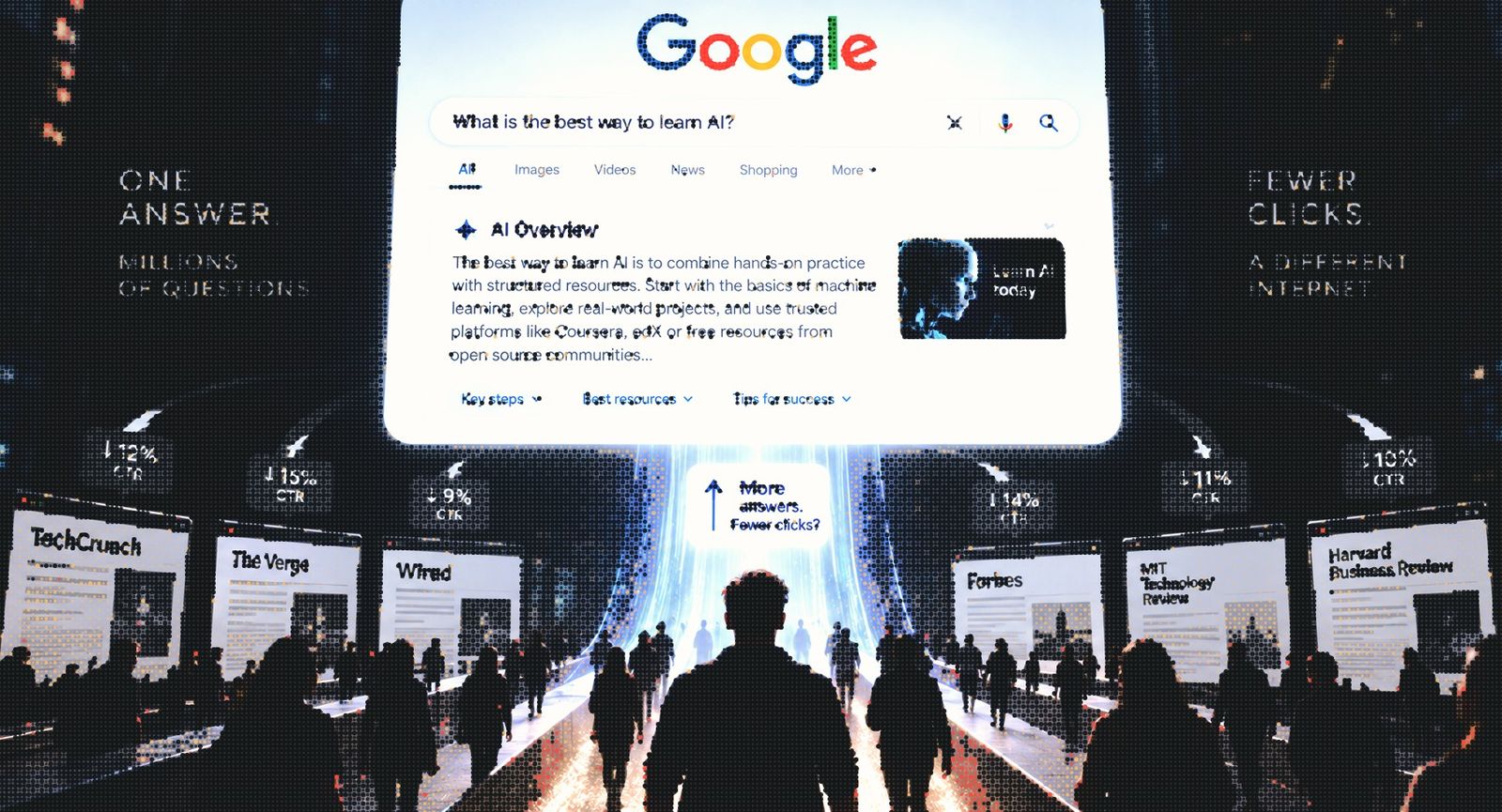

An AI answer can satisfy a reader before the reader visits a single website. For someone looking up a simple fact, that is a useful shortcut. For the person who researched, tested or reported the information, it may mean their work was useful without their site gaining a visitor.
That tension is becoming measurable. Recent research examines how Google’s AI search features affect the journey from a question to an outside source. The findings raise a practical question for anyone who uses the web: what happens when discovering an answer no longer means discovering who produced it?
An experiment changed the search experience
A preregistered experiment, posted as a preprint on August 18, 2026, analyzed 1,100 US participants who searched during a seven-day intervention in March. Researchers from the University of Pennsylvania and Northeastern University assigned them to ordinary Google Search, search with AI features hidden, or searches redirected into AI Mode.
Assignment to AI Mode reduced the external click-through rate by 18.8 percentage points compared with ordinary search. The measure counted external clicks per search, with each AI follow-up prompt counted separately. That is a change in a rate, not an 18.8% fall in every publisher’s traffic. The AI Mode group also reported lower trust and satisfaction. Read the experiment.
The design has a crucial limit: people were pushed into AI Mode, rather than choosing it for suitable questions. The short trial and sample, which skewed younger and more educated, also limit generalization. This is evidence about a specific interface and intervention, not a verdict on every use of AI search. As of September 14, the cited version is a preprint.
Wikipedia offers a different view of the effect
A second preprint, revised on September 2, examines search referrals to Wikipedia. Researchers Mehrzad Khosravi and Hema Yoganarasimhan used the staggered geographic rollout of AI Overviews and compared English articles with versions of the same articles in German and French.
They estimate that default availability of AI Overviews reduced English Wikipedia’s external-search traffic by 5.45% using the German comparison and 4.82% using the French comparison. These are two estimates of a similar effect, not losses to add together. Read the updated Wikipedia study.
Unlike the randomized experiment, this analysis depends on an assumption: without the rollout, traffic to the compared language editions would have followed sufficiently similar trends. The authors test that assumption, but the comparison cannot recreate a controlled experiment.
The result concerns a particular source of Wikipedia traffic. It does not show that all Wikipedia visits fell by five percent, or that every website faces the same loss. Its value is narrower: it examines whether introducing an answer above the links changes how much search traffic reaches an information publisher.
A citation can be visible and rarely visited
There is also a distinction between including sources and sending people to them.
A study posted on August 5, using browsing records from 900 US adults in March 2025, found that visits to Google pages with AI Overviews led to clicks on cited sources only about 1% of the time. AI Overviews were also associated with fewer clicks on ordinary results. This was observational evidence, so the authors do not claim that the summaries caused those differences. Read the browsing study.
Its methods deserve attention. The researchers reconstructed search pages in April after collecting March browsing records and matched clicks to up to three prominently cited sources. The result is informative about that measurement and interface; it is not a complete count of every citation interaction in today’s Google.
For readers, the implication is straightforward. A link beside an answer provides a route to verification. Verification itself requires opening the source and checking whether it supports the particular claim.
Google argues that AI can expand discovery
Google presents a more optimistic account. In a public post, executive Nick Fox said AI features in Search were sending billions of clicks to websites each week and encouraging people to search more. Read Fox’s statement.
An earlier explanation from Google, published in August 2025, said overall organic click volume was relatively stable year over year and that click quality had improved. Google defined higher-quality clicks as visits where people did not quickly return to Search. Read Google’s explanation.
These claims address different questions from the studies. Total clicks across Google, clicks per search and traffic to a particular publisher can move in different directions.
For a simple hypothetical example, suppose 100 searches produce 40 external clicks. Later, 150 searches produce 45. Total referrals have risen, while clicks per search have fallen from 0.40 to 0.30. A particular website could receive fewer of those visits, even as the total grows.
That arithmetic does not verify Google’s claims or establish what happened across the web. It explains why a large aggregate number cannot settle the argument by itself.
What changes for readers and publishers
There are good reasons to welcome a useful answer delivered quickly. Reading several pages to locate a straightforward fact is not inherently better than receiving an accurate summary with a clear source.
The difficulty comes when the shortcut removes context that matters. A product comparison may depend on which versions were tested. A research finding may apply to a small sample. A confident answer may flatten a disagreement that becomes obvious when the underlying sources are opened.
A practical reading habit is to follow the source when a claim will shape a decision. Check the date, the evidence and the scope. If an answer combines several claims, one credible citation should not be treated as validation for the entire paragraph.
For publishers, these findings suggest separating three outcomes: appearing as a source, receiving a visit and building an ongoing relationship with a reader. Each can have value, but they are not interchangeable. A citation count alone cannot reveal whether people arrived, subscribed or returned.
Useful responses might include showing original evidence clearly, making full methods accessible and giving readers a reason to remember the publication. Those are editorial choices worth testing, not guaranteed ways to recover search traffic.
The deeper issue is how the next useful source gets made. Someone still has to run the experiment, test the product, interview the people involved or maintain the reference page. If AI makes that work easier to consume, its success should also be judged by whether the people producing it can continue.
A good AI answer saves the reader effort. A healthy search system also makes the route back to the evidence easy to see and worth taking.


